I’ve always enjoyed the wild empty spaces of Mongolia – I’ve had an apartment in the capital city, Ulaanbaatar for nearly 20 years, when I used to fly up for weekends to escape the boorish Beijing expatriate crowd – UB is just a 90 minute flight from Beijing’s capital airport.
Once in Mongolia, everything changes. Not Chinese, not Russian, not anything other than what it is – a country so at one with its natural surroundings that it was once the largest empire the world had ever seen. Proof perhaps that a lot can be achieved if man works with nature rather than trying to bend it to human rules.
On this occasion, I am off to the far west of Mongolia, to Khovd, which is about 150km west of China’s Xinjiang Province, about 500km south of Russia, and about 1,000km east of Kazakhstan, where the Altai mountains form a natural border. Historically, this region has always been on the ancient trading routes between Western China, Central Asia, and Russia, and is arguably silk – or be precise – tea and fur road territory. Forts and old garrisons litter these steppes.
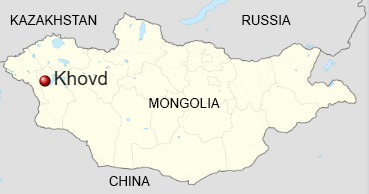
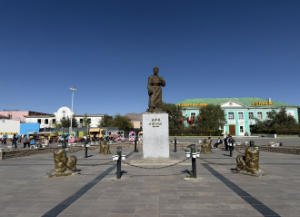
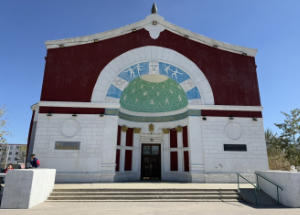
I fly into Khovd from Ulaanbaatar, a 2 hour flight, on September 28th – noticeable as it produced the first winter snow of 2026. Khovd itself is a rather charming town, still distinctly Mongolian however with traces of Chinese ‘friendship’ and historically, invasions. The small city centre is clean, neat, in that appealing Soviet-era style, and features an amazing, Chinese-built theatre, with paintings and plaster work reliefs of ballet dancers and opera signers adorning the exterior. I would like to see a performance there one day, and the local children milling around told me that they were there early for some ‘practice’.
But I am here for fishing. With my good friend and guide Tumen, we have found a local driver and trusty Landcruiser and stocking up with provisions at the huge, local Nomin supermarket head off to Khar-Us Lake (Black Water Lake), located inside the Khar Us Lake National Park. We are going to stay in a ger here and fish the lake. I am also hopeful of getting in some quality birdwatching.
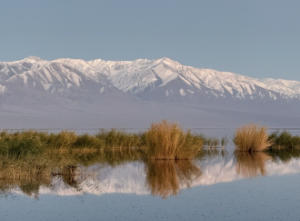
The Lake is stunningly beautiful, and given the late September snows, is topped off to the north by the Khar-Us mountains – part of the Altai range. The snow melt feeds the Lake, which in turn feeds the Khovd River, which I am here to fish.
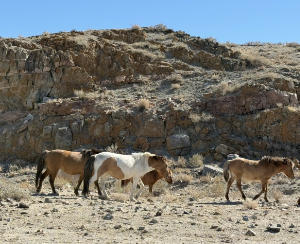
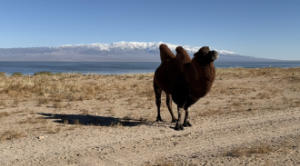
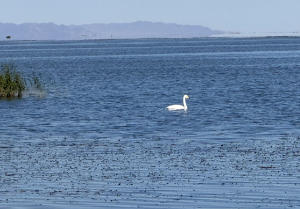
Travelling along the Lakeside to get a visual picture of the surroundings, I come across camels as well as horses, and a wide variety of passage migrants – Spoonbills, Whooper Swans, Pelicans and Ruddy Shelduck along with many resident Coots and Great Crested Grebes. It is an amazing place, tranquil and serene.
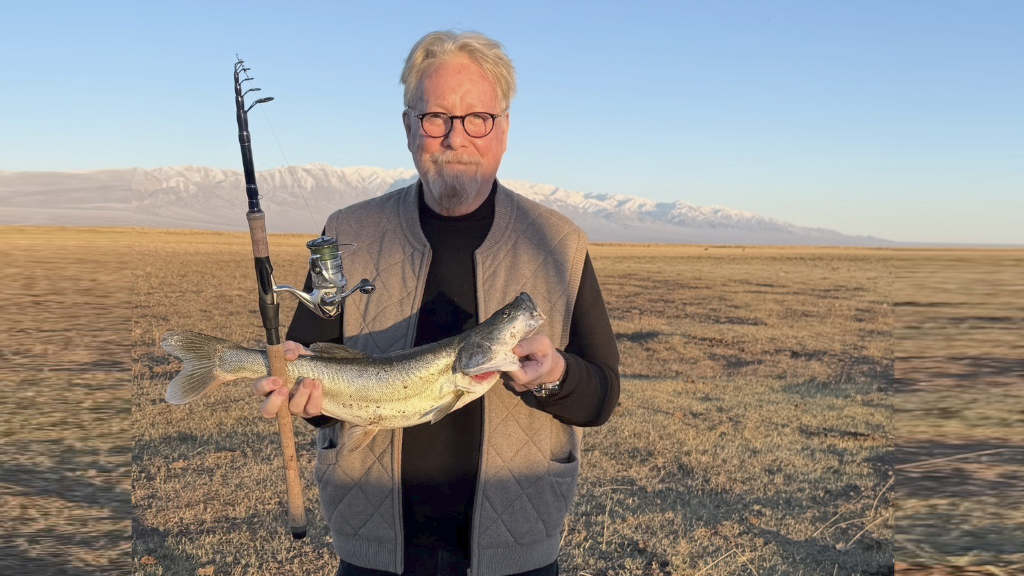
The fish captured was a large Greyling (main image) which was consumed the next morning for breakfast. These fish are related to Trout and generally prefer fast running, clean rivers, although they can also be found in large lakes like Khar-Us. They are a delicacy in France, but the British never took to them much. This fish was taken on a minnow-sized lure, cast out with some weights then reeled rapidly in to resemble the lure swimming. Success!
We breakfast by the Lakeside to enjoy the views before stopping off at a local ger to have a cup of tea and some locally produced cheese and cream – the typical Nomadic Mongolian snack.
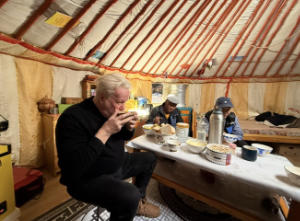
That morning, we are en route to Bayan-Olgii – a 150km drive further North-West. I am reminded along the route about how close we are to China’s Xinjiang Province, a region I know well. New main roads pass through here, connecting China with Russia via Khovd, with the signposts a give-away. This area represents a high-altitude desert route between Siberia and China, and the occasional trucks are seen along the highways.
But away from the trilateral commerce, we stop by the River Khovd where a local friend of our driver has turned up to give us a private concert, by the River of traditional Mongolian songs played on musical instruments – the Morin Khuur (Horse Head Fiddle) and masterful throat singing. These are sounds of the land – nature, and freedom.
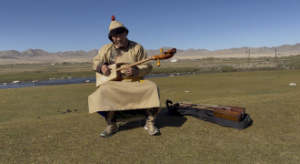
It is an impressive, personal concert. We pay tribute to the land by flicking some vodka north, south, east and west and continue our journey – following the River Khovd north for more fishing – and to attend the Eagle Festival in Bayaan-Olgii.