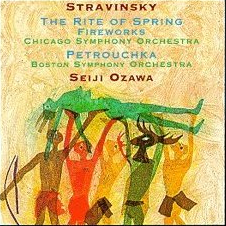
 Stravinsky’s Rite of Spring, also commonly referred to by its original French title, “Le Sacre du Printemps†is a ballet piece that was commissioned by Les Ballet Russe maestro Serge Diaghilev. The music’s innovative complex rhythmic structures, timbres, and use of dissonance have made it a seminal 20th century composition. Premiered at the Theatre des Champs-Elysee in Paris in May 1913, the premiere involved one of the most famous classical music riots in history. The intensely rhythmic score and primitive scenario shocked audiences more accustomed to the demure conventions of classical ballet, and the audience went on the rampage. Composer and conductor Leonard Bernstein has said of one passage, “That page is sixty years old, but it’s never been topped for sophisticated handling of primitive rhythms…”, and of the work as a whole, “…it’s also got the best dissonances anyone ever thought upâ€.
Raageshwari – Sagari Rayn
 Well ok, Raageshwari is a friend of mine in Bombay, but this is nonetheless an excellent slice of Arabic-India pop fusion that is at once both alluring, exotic and pop. Born to an Indian nationally recognized musician, her Father Trilok Singh Loomba is an established composer in his own right – Raageshwari came to prominence in India with her first CD. It was a collection of admittedly Hindu pop songs, but catchy, with the track Duniya becoming the summer hit of the year. That was followed with a reintroduction of Egyptian belly dancing to Indian popular club culture with her CD Pyaar Ka Rang. Raageshwari has a repertoire ranging from Pop songs to Ballads, Bhangra to Bollywood, London Club to Underground Pub, Sufi to Disco. In incorporating regional rhythms into what are essentially Hindi songs, Raageshwari is succeeding, in a somewhat sugary, but nonetheless evocative way Arabic and Persian influences into India, in a much trodden cultural path that essentially stopped from the early days of the Raj. Her next CD, Ginans – Lifting the Veil is a spiritual, devotional, Sufi album based on the Shia Imami Ismaili Ginans. Raageshwari will dedicate it to the people of Islam and intends to release it to spread the message of brotherhood, peace and secularism. For a sound of what’s on the streets today in Mumbai, then Raageshwari’s summer grooves are a pleasant way to enjoy a glass of Sula and relax in one of Bombays many rooftop cafes overlooking the Arabian sea.
Three Operas For Christmas
Tchaikovsky "Vakula The Smith" / "Cherevichki" / "The Slippers"
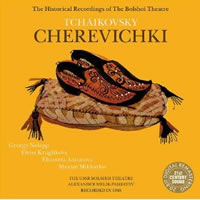 A silly but entertaining yarn set on Christmas Eve, The widow Solokha agrees to help the Devil steal the moon. The Devil is annoyed with Solokha’s son Vakula who painted an icon mocking him, and decides to create a snowstorm to prevent Vakula from seeing his beloved Oxana. Vakula enters and watches her admiring herself. She teases him, and he says he loves her. Chub comes back out of the storm, and Vakula, not recognizing him, chases him out by striking him. Seeing what he has done, Oxana sends Vakula away in a miserable state. Young people from the village come around singing Ukrainian Christmas carols. Oxana realizes she still loves Vakula. Three men and the Devil wind up in three sacks at Solokha’s hut after successively trying to seduce her, and Vakula winds up hauling the heavy sacks away. Outside three groups of carollers contend. Oxana shames Vakula into getting her the Tsaritsa’s boots or else she won’t marry him. The Devil takes Vakula away as Russian and Cossack dances commence. The next scene takes place at the town square on a bright Christmas morning. Solokha and Oxana think Vakula has drowned himself and mourn for him. Oxana runs off weeping when villagers invite her to the Christmas feast. Vakula returns with the boots, asks Chub to forgive him for the beating and asks for Oxana’s hand in marriage. She enters, tells Vakula that she wants him, not the silly boots. Chub calls for the kobzari (the lutenists), and everyone celebrates. The opera premiered at the Mariinsky in 1876, however Tchaikovsky revised it in 1885 as Cherevichki (The Slippers) and it is usually seen now under this title.
Wintereisse
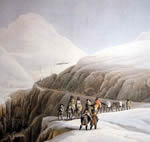 The Wintereisse are probably the most well known of any collection of songs about winter. Written by the German poet Wilhelm Muller, they are a 26 song cycle, most famously set for male voice and piano by Franz Schubert in 1827. They are no party; the songs deal with the loneliness of solitiude, the bleakness and cold of the season, rejected love, and the contemplation of death, something that should appeal to Morrissey fans. Over the course of the cycle the poet, whose beloved now fancies someone else, leaves his beloved’s house secretly at night, quits the town and follows the river and the steep ways to a village. Having longed for death, he is at last reconciled to his loneliness. The cold, darkness, and barren winter landscape mirror the feelings in his heart, and he encounters various people and things along the way which form the subject of the successive songs during his lonely journey. It is in fact an allegorical journey of the heart. In doing so, Muller also captures the melancholy feel of winter, while Scubert’s sparse piano work demonstrate the icy touch of frigid despair.
Originally scored for tenor, they are now often transposed to baritone, bringing an additional gravitas and level of gloom to the proceedings. Marvellous in their utter depression and despair, I thoroughly recommend a good listen during a howling, snowing night, indoors next to a roaring fire, a dog at your feet and a bottle of 18 year old Glenfiddich malt to hand. Just make sure someone else has the key to the shotgun cabinet.
Sting – If On A Winter’s Night
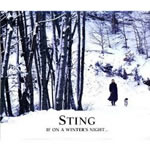 Sting is a bit of a curious fish. Part spiky haired pseudo punk, jazz idealist, tantric sex master, rainforest savior, dodgy film star and now classical musician, his credibility has often veered between naff and intoxicating. His recent musical leanings however have seen him take in an album of 18th century lute music, which was actually rather beautiful, and now this, his ode to the Christmas season. I’m always concerned about "Christmas" themed albums, invariably crap, I’m not a big fan of sonic powered "White Christmas" duets by rap superstars. However, on the back of his "Songs From The Labyrinth" which although pretenciously titled, was an exercise in 300 year old English folk, and as I said, rather good. Winter, rather than Christmas however is the theme on offer, and it is also, it transpires, the good Sting’s favorite time of year. Hence, rather than "Rudolph The Red Nosed Reindeer" we get a selection of seasonal songs, mostly dark in texture and hue as he summons up the ghost of Christmas in mildly scary, depressing form than any celebratory exercise. Pushkin would have approved. Songs invoking imagery such as "freezing", "bleak", "ice", "haunting" and "darkness" dominate here, in fields of snow far away from Roxanne’s red light lost angst. Accompanied by classical guitar, mandolin, harp, tuba, harmonium and the tablas of India, Sting has indeed pulled off again, somethig remarkable yet undoubtedly Sting-like. For a chameleon of rock, Sting in his middle age is still capable of producing the goods for a more selective, mature audience.
Jazz Mozart – Bobby McFerrin & Chamber Music
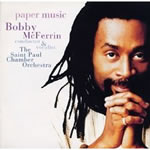 Bobby McFerrin is a classically trained, experimental jazz singer with an incredible vocal range. Employing drumming by using his own body, and regarding his voice as an instrument, he is best known for the mid-1980’s hit single "Don’t Worry, Be Happy". Since then, he has consistently fused his eclectic style of jazz and scat singing with classical music, as first seen on his collaboration with Yo-Yo Ma, on the recording "Hush". Here, McFerrin combines forces with the Saint Paul Chamber Orchestra, fulfilling the roles both of conductor and vocalist. Featuring compositions by Mozart, Faure, Stravinsky, Tchaikovsky, Bach and Mendelssohn this could have turned into an almighty dogs dinner. However it is much to McFerrin’s credit that it does not, and instead he has created a marvellous record of style, homage, wit and beauty. If melody, the classics, and jazz are your thing, then this CD will both surprise and delight.
Bobby McFerrin "Paper Music" Sony Classical SK64600
Tchaikovsky’s Double Bill
I’m a big fan of Opera, having previously sung in various productions (I’m a tenor) and have a particular liking for Russian opera, with all its great choral work and dastardly plots. (I wasn’t that good a tenor, hence my empathy for the chorus line, being shoved in the back to tweet merrily with others of my ilk). Tchaikovsky of course needs no introduction as one of modern Russia’s most gifted and prolific composers, however he tends to be known more for his ballets than opera. In fact, he wrote several operas, with Eugene Onegin and Queen of Spades being the best known, and Sleeping Beauty and Swan Lake being his best loved ballets. However, it’s Tchaikovsky’s lesser operas that I find more satisfying, and it was with interest I came across a hard to find CD of “Iolanthe” being performed by the Kirov Orchestra under the baton of Valery Gergiev
Russia’s best known conductor, performed at the Mariinsky Theatre.
Gordon Shi-Wen – Formosa Seasons For Violin & Strings
 Gordon Chin is a Taiwanese composer, with several orchestral, choral and chamber works to his credit. Formosa Seasons is dedicated to the Taiwanese violinist Cho-Liang Lin, and is based on a set of poems the composer wrote with the same title. Depicting the “sound of wind, the smell of trees, the beauty of twilight and the laughter of children” throughout the Chinese seasons of the year. It’s a great and interesting piece encompassing both Western classical music structures with Chinese melodies.
Grateful Dead – To Terrapin: Live in Hartford 1977
 The Grateful Dead are one of rocks seminal acts, but curiously better known for their long, mazy and intricate live performances than any work they did in the studio. Perhaps the definitive American band, their heyday was in the 1970’s when they performed some of the most intellectually challenging, yet melodic and even funky music thus recorded in the genre. They were at their very best during this concert, which has been cleaned up and released for the first time. The band never objected to their live performances being bootlegged, and many of them exist, but to have this, remastered and repackaged by a major studio just shows them at their most creative. My personal highlight: the 17 minute jam that is “Sugaree”, with Jerry Garcia’s excellent guitar playing prominent throughout.
Omara Portuondo – Gracias
 This new set by the Grande Dame of Cuban music – she’s now 79 – is a thank you (hence the title) to her friends all during her 60 year old recording career. A member of the legendary Buena Vista Social Club, this CD encompasses Cuban dance and love songs from the 1930’s and 1940’s, when Sinatra and Hemingway used to booze, brawl and love at Havana’s famed nightspots. It’s an eclectic collection of Cuban music at it’s very best, and one cannot help but be charmed by the gravitas and stately romance her aged voice brings to the songs.